Estha’s traumatic silence and withdrawal
The God of Small ThingsEstha’s traumatic silence and withdrawal define the altered life he leads after being sent away and return, years later, as a bodily posture of waiting: sitting straight in the dark, hands in his lap, as though an inspection or arrest were imminent. His silence does not resolve the past; it carries the pressure of what happened into the adult homecoming, where even intimacy with Rahel takes shape through whispers, touch, and a long shared quiet.
Identity and Background
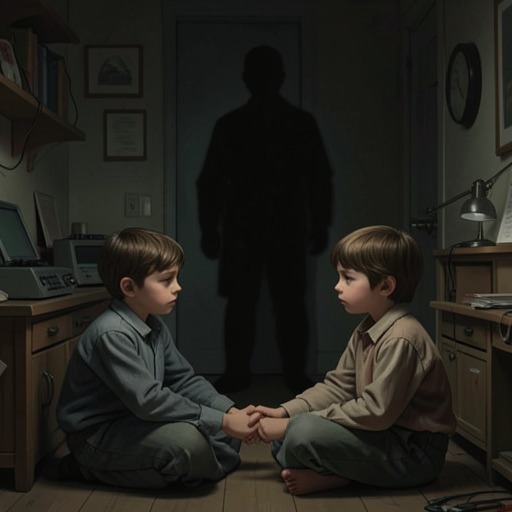
Estha’s adult presence in Ayemenem is described as neither old nor young. The phrase places him outside an ordinary measure of time, as if his life has remained suspended rather than simply advanced. In the clean room of the dirty Ayemenem House, he sits on his bed in darkness, shoulders squared and hands in his lap. The posture is precise and controlled, but its suggested purpose is not comfort: he seems to be waiting for inspection or arrest.
The contrast between the room and the house around it gives his withdrawal a material setting. His room is clean, while the Ayemenem House is dirty; inside that room he keeps still, upright, and apart. The composition presents silence not as a general trait but as a way of inhabiting a place and a body after the events that drove him away.
Life and Plot Trajectory
Estha’s silence belongs to a history of separation and coercion. In the earlier police-station episode, Baby Kochamma chooses him as the more practical, tractable, farsighted, and responsible twin, and he goes with the police. He is taken into the Kottayam police station, where he is made to identify Velutha. The adult posture of waiting to be arrested recalls that institutional encounter: the police station is no longer the immediate setting, but its pressure persists in the way he sits.
Twenty-three years later, Rahel returns to him in the dark. The novel sets this reunion against the earlier separation: the years pass, yet the account does not show Estha simply recovering the speech or ease that was lost. Instead, the past returns in a compressed, bodily scene, in which the twins face one another without a conversation capable of explaining everything that has happened.
At home, Estha continues a quiet routine of care. The ironing is finished and placed in a neat pile on the ironing board, and he has done Rahel’s clothes as well as his own. The detail matters because it gives his withdrawal a practical form: he can perform the ordered task, and he includes his sister in it, even while remaining seated alone in the dark. Competence and isolation coexist rather than cancel each other out.
Relationships and Contact
Baby Kochamma watches the twins after noticing that they have returned together from somewhere, apparently having spent the night out. Their closeness unsettles her. She wonders what they remember, when they will leave, and what they are doing together for so long in the dark. Her questions register the family’s unease around the return of a past that is not openly discussed; she tries to account for the twins from outside, while their shared history remains inaccessible to her.
Rahel’s presence reaches Estha through a form of communication that does not depend on ordinary conversation. She whispers his full childhood name, “Esthapappychachen Kuttappen Peter Mon,” and moves her mouth. Estha raises his fingers to it, following the shape of the words as if to keep the whisper through touch. He feels the touch of her teeth; she holds and kisses his hand. The scene makes bodily contact a way of receiving speech, without turning that moment into a claim that his silence has ended.
The reunion joins estrangement to deep prior knowledge. The twins are described as strangers who have met by chance, yet as people who knew each other before life began. That contrast captures the difficulty of their renewed relationship: the separated adults are not simply restored to the children they were, but neither are they strangers without a shared past. Rahel draws Estha down beside her, and they lie awake together for a long time.
Silence, Memory, and Ending
The narrative links Estha’s stillness to the account of his forced role in Velutha’s arrest. At the police station, Baby Kochamma sends him in, and he is carried into the station on a “terrible mission”; in adulthood, his squared shoulders and expectation of arrest make that earlier coercion reverberate without retelling it directly. The recurrence is structural as well as psychological: the past does not arrive as a complete explanatory speech but as a posture and a scene of waiting.
Rain surrounds the reunion. It falls steadily at night against the window bars and breaks into spray over Rahel’s face and bare arm. When Estha reaches toward her moving mouth, his hand is pressed against a cheek wet with shattered rain. The weather does not explain his silence, but it gives the scene an unstable surface on which speech, touch, and memory meet.
The encounter ends not with clarification but with an acknowledgment of what cannot be cleanly separated. The narration resists drawing a firm boundary between sex and love, or between needs and feelings, and says very little can clarify what happens next. Estha and Rahel remain awake together in the dark, in “Quietness and Emptiness.” The ending leaves his withdrawal neither cured nor wholly untouched: contact has occurred, but the scene preserves the silence around it as part of the reunion’s meaning.